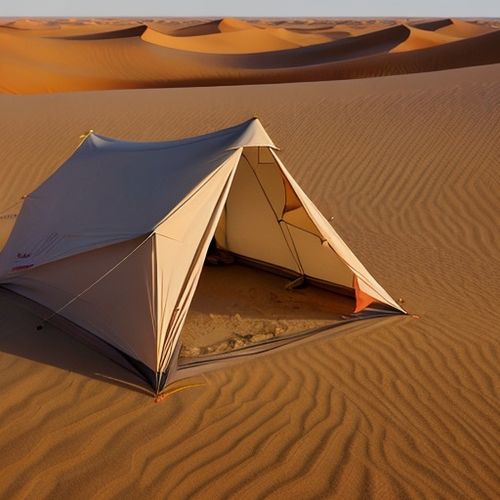
The vast expanse of the Sahara Desert presents a unique challenge for those who call it home, even temporarily. Nomadic tribes and modern adventurers alike must grapple with the relentless winds, shifting sands, and extreme temperatures that define this unforgiving landscape. At the heart of their survival lies a seemingly simple yet profoundly ingenious solution: the art of tent anchoring. This practice, refined over centuries, is as much about cultural heritage as it is about practical necessity.
Traditional Saharan tents, often referred to as khaimas or bivouacs, are not merely shelters but mobile homes designed for life in constant motion. Their structures vary across regions, with some tribes favoring camel-hide coverings while others opt for tightly woven goat hair that expands when wet, creating a waterproof barrier during rare rainfall. The real marvel, however, isn't just the tent's portable design but how it remains steadfast against desert forces that could reduce lesser structures to tattered ribbons.
The secret begins with understanding sand's behavior. Unlike soil, sand lacks cohesive strength—it cannot hold shapes or bear weight without constant rearrangement. Early nomads observed how certain desert plants like the hardy tamarisk shrub maintained stability by sending roots horizontally just beneath the surface rather than digging deep. This inspired the development of broad, plate-like anchors that distribute a tent's tension across wide areas of sand. Modern engineers would later identify this as an early application of what's now called "geotechnical spreading load theory."
Materials play an equally critical role. Anchors are typically crafted from dense acacia wood or salvaged metal, their mass calculated to counterbalance wind forces without being so heavy as to impede mobility. The Tuareg people often incorporate leather straps that stretch minimally under tension, allowing subtle movement during windstorms without compromising structural integrity. These straps connect to guy lines made from twisted animal sinew or palm fibers—materials that withstand ultraviolet degradation better than many synthetic alternatives.
Wind patterns dictate anchoring geometry. Saharan winds don't blow uniformly; they arrive in pulsating gusts that can change direction abruptly. Experienced tent erectors deploy a radial anchoring system with lines angled at 45 degrees rather than straight out. This creates a three-dimensional web of resistance that absorbs energy from any direction. The Imraguen fishermen of Mauritania add another layer by suspending small sandbags midway up their guy lines—these dampen harmonic vibrations that could otherwise amplify destructive oscillations during prolonged storms.
Microclimate selection proves equally vital. Seasoned travelers know to pitch tents not in dune troughs where cold air pools at night, nor on exposed crests where winds peak, but along the windward third of a dune's slope. Here, sand particles saltate (bounce along the surface) rather than accumulating into drifts. Some Berber groups deliberately position tents to create eddies that sweep sand around rather than beneath the structure, a technique later adopted by Antarctic researchers dealing with similar challenges.
The anchoring process itself is a ritualized performance. Teams work in coordinated silence, first compacting the sand by rhythmic stomping before laying ground cloths woven with stabilizing patterns. Anchors are buried at precise depths—too shallow and they'll lift; too deep and retrieval becomes laborious. The final step involves "walking" the structure: gently rocking the tent frame to settle all components into dynamic equilibrium. This careful choreography can take hours but means the difference between waking buried under a sand drift or resting securely through a haboob's fury.
Contemporary materials have introduced new possibilities without displacing traditional wisdom. High-strength polyester ropes now complement natural fibers, and helical screw anchors inspired by desert ant nests offer remarkable holding power. Yet many nomads intentionally preserve older methods, recognizing that high-tech solutions often fail when sand infiltrates moving parts or when replacement materials are unavailable weeks from civilization. There's profound resilience in systems where every component can be fashioned from local materials using nothing more than a curved knife and generations of embodied knowledge.
This expertise is now being documented not just for anthropological preservation but for practical applications. NASA has studied Saharan anchoring techniques for potential Mars habitat designs, while disaster relief agencies adapt these methods for securing emergency shelters in post-cyclone sandscapes. Perhaps most remarkably, certain anchoring principles have influenced modern architecture—the tension distribution concepts behind Dubai's Burj Khalifa show striking parallels to how a Bedouin tent withstands desert winds.
To witness a Saharan tent standing firm against a 60-knot gale is to observe a masterpiece of human ingenuity. There are no blueprints, no engineering certificates—just an unbroken lineage of problem-solving etched into muscle memory. Each properly secured guy line represents a victory over entropy, a temporary claim on order in Earth's most chaotic terrestrial environment. As climate change expands arid regions globally, these ancient techniques may find new relevance far beyond their desert cradle.
By Thomas Roberts/Apr 14, 2025

By Laura Wilson/Apr 14, 2025
By Jessica Lee/Apr 14, 2025
By Benjamin Evans/Apr 14, 2025
By George Bailey/Apr 14, 2025

By Emma Thompson/Apr 14, 2025
By John Smith/Apr 14, 2025

By Michael Brown/Apr 14, 2025
By Megan Clark/Apr 14, 2025
By Jessica Lee/Apr 14, 2025
By Sarah Davis/Apr 14, 2025
By Laura Wilson/Apr 14, 2025
By Sophia Lewis/Apr 14, 2025

By Natalie Campbell/Apr 14, 2025

By Eric Ward/Apr 14, 2025

By Laura Wilson/Apr 14, 2025

By Sophia Lewis/Apr 14, 2025

By George Bailey/Apr 14, 2025

By Laura Wilson/Apr 14, 2025

By Daniel Scott/Apr 14, 2025